Black Belt Helm S
Japanese name: クロオビSヘルム (Monster Hunter Portable 2nd G official guidebook, Enterbrain, 2008, pp. 804–949).
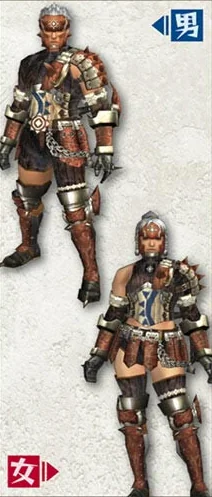
Filled with soul and given upon training completion. A reminder of your instructor.
| Part | Head |
|---|---|
| Hunter type | Blademaster and Gunner |
| Rarity | 8 |
| Defense | 30 |
| Resistances | Fire +3, Water +3, Thunder +3, Ice +3, Dragon +3 |
| Slots | 0 |
| Price | 10,500z |
Skills
Materials
- Rare Scarab x4
- Expert Ticket x6
- Kirin Coin x10
- Fire Coin x12
Improve Armor
- Armor Sphere x1, up to level 2
- Armor Sphere+ x3, up to level 5
- Hrd Armor Sphere x1, up to level 6
- Hvy Armor Sphere x1, up to level 7
Each sphere raises the piece one level from level 1, up to the level shown; the next sphere takes over from there.
From the guide book
Hunter types
Hunters are split into two types by the weapon they carry: a melee weapon makes you a Blademaster, a ranged weapon makes you a Gunner. Each type has its own traits, and each wears different armor. Both have their good and bad sides, so think about which one moves more easily against the monster you are hunting, then pick your weapon.
Blademaster
A hunter whose weapon is made for fighting up close to the monster. The risk is that monster attacks land more easily. Blademaster armor has high defense across the board.
Gunner
A type that keeps a set distance from the monster. Its strength is that monster attacks rarely reach it. But Gunner armor has low defense, so a single hit is often enough to finish you.
Our translation of the Monster Hunter Portable 2nd G official guidebook (Enterbrain, 2008), p. 96.
Armor series
Armor whose pieces share a name like "Kut-Ku" or "Garuga" is grouped in this book as the Kut-Ku series, the Garuga series and so on. A full set of one series looks matched, and its pieces often carry the same skill tree, so skills are easier to activate. Until you get used to how skills work, we recommend wearing one full series: it is the easy way to get a skill going.
Our translation of the Monster Hunter Portable 2nd G official guidebook (Enterbrain, 2008), p. 98.